

ASP Isotopes One30Seven Acquisition: Investment Tear Sheet
SEQH Capital Partners Research | October 23, 2025
Transaction Overview
Acquirer: Quantum Leap Energy LLC (QLE), wholly-owned subsidiary of ASP Isotopes Inc. (NASDAQ: ASPI)
Target: One30Seven Inc. (Canadian nuclear waste technology developer)
Transaction Date: October 21, 2025
Total Deal Value: $20.0 million (15% upfront, 85% performance-based earnouts)
Deal Structure
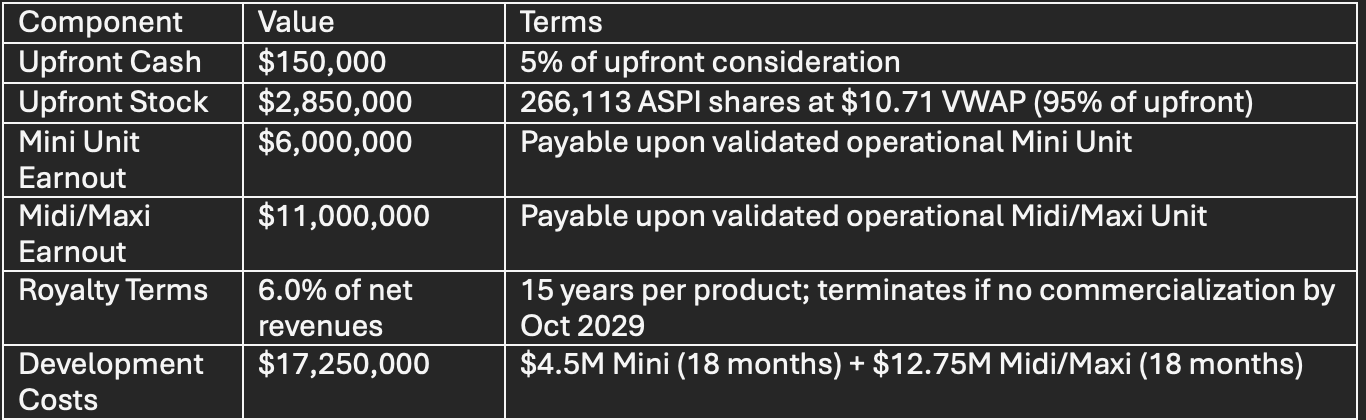
Shareholder Impact: Minimal 0.3% dilution; stock issued at $10.71 vs. current $8.91 (this morning)
Strategic Rationale
Vertical Integration in Nuclear Fuel Cycle
QLE now operates across four critical segments:
Conversion - Uranium compound processing
Enrichment - HALEU production (TerraPower: 150 MT over 10 years starting 2028)
Deconversion - Enriched fuel preparation
Nuclear Waste Processing - NEW - Creber Units for water-soluble waste remediation
Market Opportunity
U.S. DOE Liability: $44.5 billion for commercial spent fuel disposal (2024)
Global Nuclear Waste: 390,000 metric tons (90,000 MT in U.S.)
High-Level Waste (HLW): 3% of volume, 95% of radioactivity, primary Creber Unit target
Nuclear Waste Management Market: $5.1B (2025) → $6.0-7.1B (2032-2033)
Technology and Business Model
Creber Units: Accelerated Beta Decay Technology
Target Isotopes: Cesium-137 and Strontium-90 (30-year half-lives)
Claimed Mechanism: Accelerate beta decay to rapidly convert long-lived isotopes to stable forms
Product Tiers: Micro, Mini, Midi, Maxi, modular deployment strategy enabling scalable capital deployment and mobile emergency response capability
Dual Revenue Model
1. Nuclear Waste Remediation Services
Target customers: Commercial utilities, DOE facilities, international operators
Value proposition: Reduce storage liability, accelerate waste volume reduction
2. Barium-137 Byproduct for Quantum Computing
Cs-137 decay produces stable Ba-137, critical for ion-trap quantum computing
ASPI announced Ba-137 purchase order (Sept 2025) for Q1 2026 delivery
Quantum computing market: $3.52B (2025) → $20.20B (2030) at 41.8% CAGR
Ion-trap quantum market: $370M (2024) → $3.4B (2033) at 28.7% CAGR
Competitive advantage: Waste-to-value circular economy model, extracting high-value material from paid waste processing
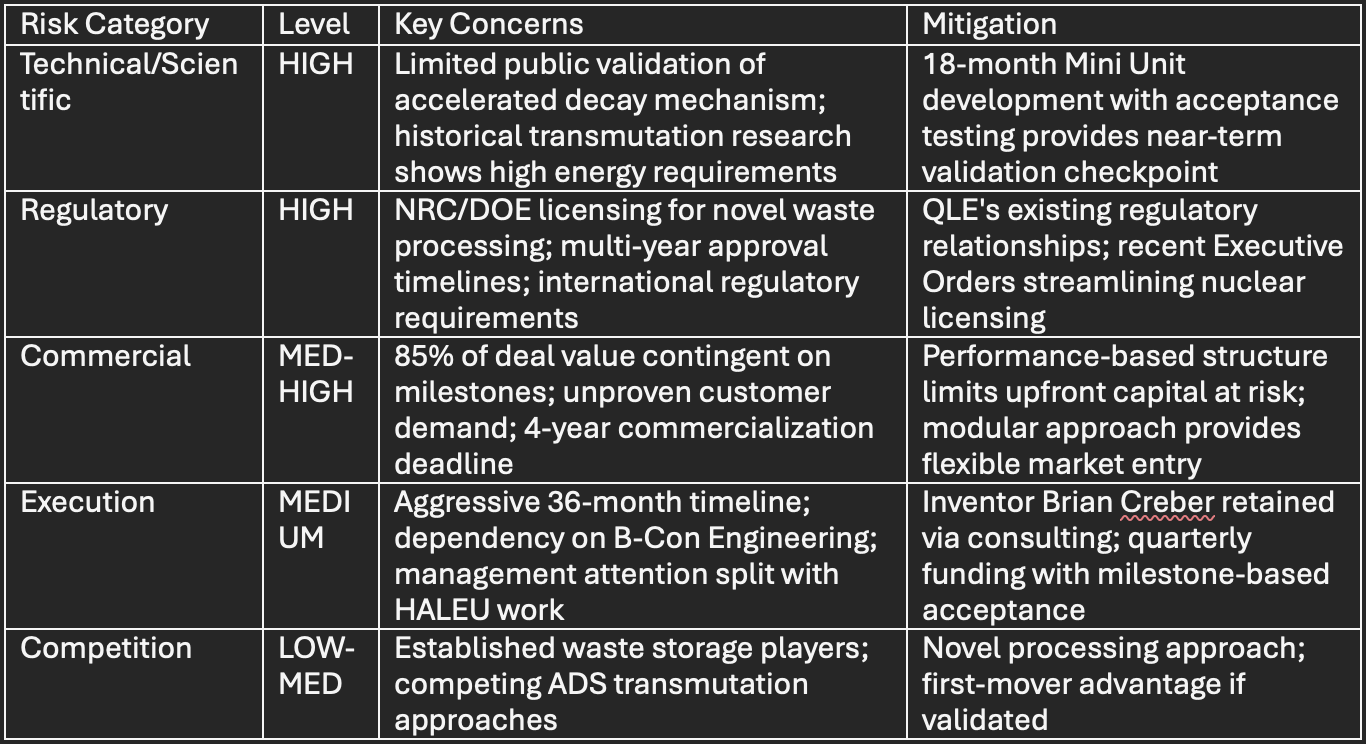
Risk Assessment
Investment Implications
Bull Case: Multi-Billion Dollar Opportunity
Technology validates with demonstrated accelerated decay rates
Clear regulatory pathway due to waste remediation benefits
DOE strategic engagement given $44.5B liability reduction potential
Profitable dual-revenue model (waste services + Ba-137 quantum computing materials)
QLE emerges as unique vertically-integrated nuclear services provider
Base Case: Niche Market Contribution
Technology demonstrates efficacy but economics challenged by energy/processing costs
Regulatory approval achieved but 3-5+ year timeline
Modest revenue contribution in specialized waste stream applications
Hundreds of millions in value creation within broader QLE portfolio
Bear Case: Value Destruction
Technology fails to demonstrate claimed capabilities
Regulatory barriers insurmountable or prohibitively lengthy
Processing economics cost-prohibitive vs. traditional storage
Earnout milestones not achieved; $3M+ development costs sunk
Key Monitoring Metrics
Immediate (0-6 months)
B-Con Engineering monthly milestone reports
Mini Unit budget adherence vs. $4.5M target
NRC/DOE preliminary regulatory discussions
QLE spin-out progress (planned 2H 2025)
Near-term (6-18 months)
Mini Unit acceptance testing and validation data
Publication of technical mechanism/peer review
$6M earnout decision and payment structure
First customer engagement or pilot program announcements
Medium-term (18-36 months)
Midi/Maxi Unit development progress
Regulatory approval pathway clarification
Commercial deployment announcements
Barium-137 production and quantum computing customer engagement
SEQH Capital Partners Investment View
Position: The One30Seven acquisition represents a high-risk, high-reward strategic option within ASPI’s portfolio, not a core near-term value driver.
Primary ASPI Value Drivers Remain:
Silicon-28/Ytterbium-176 commercial production (validated, ramping to 80kg annually)
HALEU enrichment for TerraPower (contracted 150 MT revenue starting 2028)
QLE spin-out creating separate public company valuation
Nuclear Waste Processing Adds:
Upside optionality if technology validates (18-month Mini Unit checkpoint critical)
Strategic positioning completing vertical integration across nuclear fuel cycle
Innovative waste-to-value model through quantum computing materials byproduct
Limited downside given modest $3M upfront and performance-based earnout structure
Recommendation: Monitor Mini Unit development closely over next 18 months as key determinant of acquisition value. The intersection of nuclear waste remediation and quantum computing materials represents a genuinely novel business model that could differentiate QLE if successfully executed. However, significant technical, regulatory, and commercial validation required before material revenue contribution.
SEQH Capital Partners Research
Independent Investment Research for Nuclear Energy Sector
October 23, 2025
FULL 12-PAGE REPORT BELOW:
