

Daily Nuclear & Uranium Market Recap
Monday, March 30, 2026
Market Overview
The nuclear and uranium complex closed broadly lower, with pronounced weakness in higher beta uranium, SMR, and AI exposed names, even as uranium itself held essentially flat. Uranium last settled at $84.05/lb on March 27, down 0.30% day over day and 2.78% over the past month, but still 30.61% higher than a year ago, on the main CFD benchmark. CarbonCredits reported uranium holding firm at $83.90/lb globally today, unchanged, as the market digests a standoff between a recent Uzbek production boost and still strong long term demand from AI data centers and eased U.S. regulations for domestic enrichers. Uranium Mar 2026 futures (UXH6) expired today, with CME data showing an open at $75.85and prior settle at $84.30 on March 27, highlighting how thin liquidity around expiry can distort near day prints without changing the structural picture.
Key Equity Movers, Laggards
Bloom Energy (BE) closed at $117.62, minus 11.73% on 13.2M shares, the worst move in today’s set. Zacks flagged last week that BE’s shares were falling faster than the broader market, pointing to valuation risk and a “lost opportunity” narrative after a high profile data center deal slipped, adding pressure on a stock that had already dropped about 10% in a recent session. Today’s decline extends a sharp de rating in one of the most crowded AI plus power plays.
Oklo (OKLO) closed at $45.39, minus 9.64% on 10.8M shares, and NuScale AI (NUAI)at $3.77, minus 8.95% on 2.9M shares. These names continue to trade as high beta, long dated options on SMR and AI infrastructure rather than as direct uranium proxies, and are being hit hardest as risk off flows persist.
LEU closed at $167.20, minus 8.58% on 968.3K shares, deepening a three month drawdown that Zacks recently measured at about 19 percent. This is happening despite LEU’s strong $3.8B backlog and central role in enrichment and HALEU, underscoring how aggressively the market is de risking anything that screens as high volatility or capital intensive.
LTBR closed at $9.92, minus 7.28% on 1.1M shares; SILXY at $18.25, plus 2.99% but illiquid; SMR at $10.29, minus 0.10% on 20.8M shares; NNE at $19.20, minus 5.38%; SLX AT at €5.00, minus 5.66%; UUUU at $16.40, minus 6.87%; and ASPI at $4.22, minus 3.43%. The weakness is broad across SMR, isotopes, and smaller producers.
Core Uranium and Fuel Cycle
Cameco (CCJ) closed at $102.13, minus 1.72% on 2.7M shares. Cameco’s own pricing page still shows February spot at $86.95/lb, up from $65.03 a year earlier, highlighting how much CCJ has sold off relative to a commodity that is still roughly 30 percent higher year over year.
Uranium Energy (UEC) closed at $12.58, minus 2.63% on 10.6M shares. This is further compression on a name that just reported $20.2M in Q2 revenue, $10M gross profit, sales of 200,000 lbs at $101/lb versus an $80.76/lb spot average, $818M in liquid assets, no debt, and 1.456M lbs of inventory, and which several outlets have flagged as one of the better leveraged ways to play an eventual uranium bounce.
Denison (DNN) closed at $3.30, minus 3.22% on 37.7M shares, continuing to trade heavily after its Phoenix ISR FID. The project’s roughly $600M initial capex and mid 2028 first production target remain key overhangs as the market shifts to scrutinizing funding and execution risk.
NexGen (NXE) closed at $10.87, minus 1.54%; Uranium Royalty (UROY) at $3.30, minus 1.33%; Ur Energy (URG) at $1.38, minus 2.88%; enCore Energy (EU) at $1.66, minus 7.26%; and MIR at $17.30, minus 3.30%. Selling pressure remains broad across producers, royalties, and related service names.
IPPs and Infrastructure
Vistra (VST) closed at $147.72, minus 4.99% on 4.7M shares, Talen (TLN) at $312.09, minus 3.84%, and CEG at $297.96, minus 1.17%. Theme ETFs recently highlighted that nuclear IPPs and grid operators have been a key way to play the nuclear theme as oil prices spike and AI power demand rises, especially after the March 10 Nuclear Energy Summit in Paris and the March 20 announcement of a $40B SMR initiative in Tennessee and Alabama backed by the U.S. and Japan. Today’s moves show even these “safer” nuclear plays are not immune when global stocks face their biggest monthly drawdown since 2022 amid Iran ceasefire uncertainty.
BWXT closed at $200.10, minus 1.23% on 1.0M shares, and CW at $632.06, minus 4.75%. Zacks just reaffirmed BWXT as one of the “best nuclear energy stocks to buy” on the back of its $7.3B backlog, 18 percent revenue growth, and 20 percent EPS growth in 2025, but the stock is still being treated as part of the nuclear complex in a risk off tape.
Uranium Market Backdrop
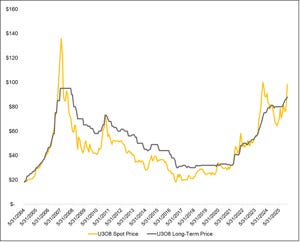
Uranium price chart
Spot and futures: Uranium fell to $84.05/lb on March 27, down 0.30% from $84.30 on March 26, and is now 2.78% lower over the past month, while still 30.61% higher than a year ago. CarbonCredits reports uranium holding at $83.90/lb globally today, with downward pressure from Uzbekistan’s boosted supply to 7,000 tonnes now stabilizing, while long term bullish demand from AI data centers and lighter regulations for U.S. enrichers keeps physical buying strong. CME quotes show Mar 2026 futures last settled at $83.90, with April at $84.05, pointing to a flat near dated curve anchored in the low to mid $80s.
Context: YCharts puts the February average uranium spot price at $71.30/lb, up from $69.71 in January and $54.32 a year earlier, a 31.27 percent year over year jump that solidifies a higher structural floor versus 2025. The Oregon Group and Sprott analyses have argued that, given persistent supply deficits, AI driven electricity demand, and policy support, uranium could still make a run toward the $120 to $150/lb range later in the cycle, with the recent pullback viewed as a healthy reset after the late January spike to about $101.50.
SEQH Desk View
Today’s session was equity pain without a matching commodity signal. Uranium flat around $84, down less than 3 percent on the month and still over 30 percent year over year, is fully consistent with a consolidation phase. In contrast, BE minus 11.7 percent, OKLO minus 9.6 percent, NUAI minus 9 percent, LEU minus 8.6 percent, UUUU minus 6.9 percent, EU minus 7.3 percent, and broad red across CCJ, UEC, DNN, NXE, and the IPPs show a sector being de risked aggressively as global stocks work through the biggest monthly selloff since 2022 on Iran and energy uncertainty.
From a positioning perspective, this keeps reinforcing the same core conclusion: fundamentals for uranium and nuclear are not what is breaking here. Big Tech and governments have just recommitted to tripling nuclear capacity, the U.S. and Japan are planning a $40B SMR buildout, and uranium remains structurally tight at a price level that still supports new FIDs. The damage is in positioning and valuation. That argues for continuing to add selectively to the highest quality uranium and nuclear names on further weakness (CCJ, UEC, LEU, DNN, UUUU, BWXT, CEG, VST) while treating the SMR and AI heavy names as trading vehicles rather than core holdings.