

Daily Nuclear & Uranium Market Recap
Monday, April 13, 2026
1. Market Overview
The nuclear and uranium complex put in a very strong continuation day, led again by AI and high beta decarbonization names, with broad green across SMR developers, fuel cycle plays, and core producers.
The uranium CFD benchmark was last quoted at 85.80 dollars per pound on April 10, flat on the day and down only 0.12 percent over the past month, while still 33.23 percent higher than a year ago, according to Trading Economics. Trading Economics now projects uranium to trade near 87.07 dollars per pound by the end of the quarter and 91.68 dollars over the next 12 months, reinforcing the idea of a new, higher structural range. Barchart’s performance report for April 2026 uranium futures (UXJ26) shows a five day range of 84.30 to 85.40 dollars, up 1.67 percent since March 31, a one month range of 83.50 to 86.50 dollars with the contract down only 0.64 percent since March 6, and a three month move of plus 3.58 percent from 83.25 to the current mid 80s, after the late January spike to 101.60 dollars. YCharts still has the February average spot price at 71.30 dollars, up from 69.71 in January and 54.32 a year earlier, a 31.27 percent year over year increase.
2. Equity Movers - Leaders
Bloom Energy (BE) closed at 200.53 dollars, plus 20.30 percent on 8.7 million shares. This is a major extension of the recent run as markets increasingly treat BE as an AI power proxy, levering its solid installed base and pipeline into data center demand.
ASP Isotopes (ASPI) closed at 5.10 dollars, plus 13.84 percent on 8.0 million shares. The move pushes ASPI back above the 5 dollar line and closer to the 5.86 to 6.32 dollar “ideal buy zone” flagged in uranium stock trading guides, although it remains well below Cantor and Canaccord’s 11 to 13 dollar targets and continues to trade as a very high beta isotope development story .
Oklo (OKLO) closed at 54.64 dollars, plus 8.73 percent on 8.4 million shares. Yahoo’s recent SMR note still positions Oklo, with its pipeline of technology and data center agreements and Bank of America’s 127 dollar Buy target, as the top pure play SMR option for establishing tangible sales momentum, albeit with high execution risk.
Lightbridge (LTBR) closed at 11.59 dollars, plus 6.82 percent.
NuScale AI (NUAI) closed at 4.54 dollars, plus 5.83 percent on 6.7 million shares, continuing to trade primarily as an AI sentiment vehicle rather than a pure uranium play.
Nano Nuclear (NNE) closed at 21.94 dollars, plus 5.68 percent. Zacks’ latest “Best Nuclear Energy Stocks” update still includes NNE among its top nuclear names, despite a roughly 41.8 percent twelve week drawdown that highlights the name’s high risk, high reward profile.
Energy Fuels (UUUU) closed at 19.38 dollars, plus 5.33 percent on 10.1 million shares.
enCore Energy (EU) closed at 1.87 dollars, plus 5.06 percent on 2.0 million shares, aided by the fundamental support of its recent year end results and ISR ramp plans .
Denison (DNN) closed at 3.73 dollars, plus 4.78 percent on 30.2 million shares, continuing to trade well following the Phoenix in situ recovery final investment decision that sanctioned approximately 600 million dollars in initial capital and targeted mid 2028 first production .
NuScale Power (SMR) closed at 9.59 dollars, plus 4.13 percent on 25.2 million shares. Alongside Oklo, SMR remains one of the two marquee SMR equities, with the broader nuclear renaissance estimated at roughly 10 trillion dollars of potential over time.
NexGen (NXE) closed at 11.84 dollars, plus 3.95 percent.
NuClear (NKLR) closed at 5.02 dollars, plus 3.93 percent.
Uranium Royalty (UROY) closed at 3.72 dollars, plus 3.91 percent.
Uranium Energy (UEC) closed at 13.92 dollars, plus 2.89 percent on 8.0 million shares. UEC’s last reported quarter showed 20.2 million dollars revenue, 10 million dollars gross profit, 200 thousand pounds sold at 101 dollars per pound versus an 80.76 dollars per pound spot average, 818 million dollars in liquid assets, no debt, and 1.456 million pounds of inventory, which continues to underpin the equity even as it trades with high beta .
Ur Energy (URG) closed at 1.54 dollars, plus 2.67 percent. Prior analysis pegs average analyst targets around 2.21 dollars, implying upside from current levels if the uranium tape remains firm.
3. Equity Movers - Quality Complex
Centrus (LEU) closed at 191.80 dollars, plus 2.45 percent. LEU remains a core fuel cycle winner with a substantial backlog and strategic position in enrichment and high assay low enriched uranium, and it continues to feature prominently in macro nuclear stock screens.
Vistra (VST) closed at 158.43 dollars, plus 2.39 percent on 4.5 million shares.
Constellation (CEG) closed at 292.00 dollars, plus 1.92 percent on 2.7 million shares. Zacks recently highlighted CEG as one of its top nuclear linked names, citing projected 31.48 percent earnings growth and 29.19 percent sales growth for the coming year.
BWX Technologies (BWXT) closed at 233.55 dollars, plus 1.73 percent. BWXT remains a core contractor with a roughly 7.3 billion dollar backlog, 12.7 percent projected earnings growth, and 16.16 percent projected sales growth, firmly on Zacks’ list of five top nuclear energy stocks for April.
Talen (TLN) closed at 326.60 dollars, plus 1.64 percent.
SLX AT closed at 5.71 euros, plus 1.42 percent.
Curtiss Wright (CW) closed at 733.64 dollars, plus 1.09 percent.
Mirion (MIR) closed at 19.41 dollars, plus 0.73 percent.
Cameco (CCJ) closed at 116.70 dollars, plus 0.57 percent, edging higher and staying tethered to the mid 80s uranium price regime.
SILXY closed at 20.16 dollars, minus 0.44 percent.
Skyline Builders (SKBL) closed at 3.33 dollars, minus 2.06 percent.
The quality complex participated, but the session’s leadership clearly came from higher beta segments, especially BE, ASPI, Oklo, SMR, and the juniors.
4. Uranium Market Backdrop
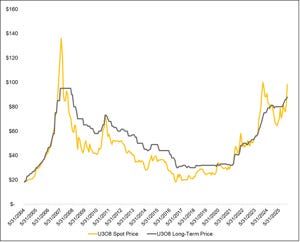
Uranium price chart
Spot: Trading Economics reports uranium trading flat at 85.80 dollars per pound on April 10, down just 0.12 percent over the past month, but still 33.23 percent higher than a year ago. The platform’s models now expect uranium to reach 87.07 dollars per pound by quarter end and approximately 91.68 dollars over 12 months, signaling that a mid 80s starting point is seen as a base rather than a peak.
Futures: Barchart’s performance report for the April 2026 uranium futures contract (UXJ26) shows:
Five day range: 84.30 dollars (plus 1.30 percent on April 1) to 85.40 dollars (unchanged on April 8), with performance of plus 1.40 dollars, or 1.67 percent, since March 31.
One month range: 83.50 dollars (plus 2.28 percent on March 23) to 86.50 dollars (minus 1.27 percent on March 17), with the contract down just 0.55 dollars, or 0.64 percent, since March 6.
Three month move: 83.25 dollars (plus 2.58 percent on January 12) to 101.60 dollars (minus 15.94 percent on January 29), for a net gain of 2.95 dollars, or 3.58 percent, since January 8.
Year to date: 82.20 dollars on January 2 to 101.60 dollars at the peak, with a net gain of 3.20 dollars, or 3.89 percent, since year end.
Structural pricing: YCharts’ February average spot price of 71.30 dollars per pound, up from 69.71 in January and 54.32 a year earlier, confirms a 31.27 percent year over yearrepricing of uranium. Sprott’s “Uranium Enters 2026” analysis shows spot and long term prices breaking out of their 2010s range, with long term contracts in the 75 to 85 dollar per pound band that can sustain new project sanctioning and an extended bull market.
Taken together, the data describe a market consolidating a powerful January move at elevated levels rather than rolling over.
5. SEQH Desk View
Today was a textbook high beta extension day on top of a still firm uranium price deck. Uranium remains pinned near 85.80 dollars per pound, effectively unchanged on a one month basis but more than 33 percent higher year over year, and the April 2026 futures contract is only about 0.6 percent off its one month reference point while still up 3.6 percent over three months and over 23 percent versus last year. Against that stable underlying, equities expressed classic risk on behavior: BE plus 20 percent, ASPI plus 14 percent, Oklo plus 9 percent, SMR plus 4 percent, Juniors DNN, UUUU, UROY, URG, EU, NXE all green, and even the quality complex in BWXT, CEG, LEU, CCJ, VST, TLN participating.
From a positioning standpoint, three things stand out:
The price deck is behaving exactly how you would want in a structural bull market: consolidating a spike at a higher level, not collapsing back into the 50s or 60s.
Capital is again rewarding the right parts of the stack. Core producers and fuel cycle names are up, but so are the SMR developers and AI linked power names, which is consistent with the narrative that data center demand will be a real incremental driver for baseload nuclear.
The barbell remains the right framework. Use CCJ, UEC, LEU, DNN, UUUU, UROY, BWXT, CEG, VST, TLN, MIR, CW as the structural core, and treat SMR, Oklo, BE, ASPI, NNE, NUAI, NKLR, SILXY, SKBL as high beta satellites that you size and trade tactically rather than anchor the book with.
If we continue to see uranium hold the mid 80s while equities stair step higher on days like this, you are in the sweet spot where frustration from the first quarter drawdown converts into performance for accounts that stayed with the thesis.