

SEQH Capital Research - Daily Nuclear & Uranium Market Recap
Thursday, April 9, 2026
1. Market Overview
The nuclear and uranium complex saw a sharp factor reversal today, with AI and high beta names (BE, NUAI) leading to the upside while core uranium producers, fuel cycle names, and IPPs gave back a chunk of yesterday’s gains, even as uranium itself continued to grind higher.
The uranium CFD benchmark rose to 85.80 dollars per pound on April 8, up 0.76 percent day over day and now down just 0.12 percent over the past month, while still 33.23 percent higher than a year ago. Investing News Network’s live chart shows spot trading around 85.17 dollars per pound this morning, confirming that the market remains pinned in the mid 80s after the first quarter spike to about 101.4 dollars per pound. April 2026 futures (ticker UXJ26) have a one month range of 83.50 to 86.50 dollars and are down only 0.58 percent since March 9, while still up 2.52 percent over three months and 23.68 percent versus April 2025. CarbonCredits’ latest note continues to characterize the spot tape as flat but “exceptionally tight,” with secondary inventory drawdowns and mine bottlenecks colliding with AI and new reactor demand.
2. Equity Movers - Leaders
SILXY closed at 20.25 dollars, plus 10.77 percent, continuing its micro cap volatility.
Bloom Energy (BE) closed at 160.40 dollars, plus 9.28 percent on 10.3 million shares. BE has now strung together several strong sessions following its late March drawdown. Zacks and Yahoo both highlight BE’s heightened volatility versus the S and P 500 as investors toggle between premium AI power valuations and strong demand from data centers.
NuScale AI (NUAI) closed at 4.37 dollars, plus 5.56 percent on 22.6 million shares, trading as an AI sentiment lever rather than a pure uranium proxy.
NuClear (NKLR) closed at 4.69 dollars, plus 4.69 percent.
Ur Energy (URG) closed at 1.58 dollars, plus 3.27 percent. Recent analysis continues to frame URG as a leveraged way to express North American in situ recovery optionality, with an average Street target around 2.21 dollars, implying upside from current levels despite 2025’s negative margins and losses.
enCore Energy (EU) closed at 1.85 dollars, plus 1.65 percent. Its year end results, including 655 thousand pounds sold at 65.89 dollars per pound and a stronger balance sheet via warrant exercises, remain a fundamental anchor.
Denison (DNN) closed at 3.58 dollars, plus 1.42 percent, continuing to stabilize after the Phoenix in situ recovery final investment decision that sanctioned roughly 600 million dollars in initial capital expenditure and targets mid 2028 first production.
Skyline Builders (SKBL) closed at 3.39 dollars, plus 1.19 percent.
Overall, AI and select smaller uranium names worked, while larger, high quality producers and IPPs took a breather.
3. Equity Movers - Laggards
Energy Fuels (UUUU) closed at 18.34 dollars, minus 0.22 percent.
BWX Technologies (BWXT) closed at 230.92 dollars, minus 0.37 percent.
NexGen (NXE) closed at 11.49 dollars, minus 0.52 percent.
Curtiss Wright (CW) closed at 722.52 dollars, minus 0.88 percent.
Constellation (CEG) closed at 281.47 dollars, minus 0.98 percent. Zacks’ April 9 update still names BWXT, DNN, CEG, Nano Nuclear (NNE), and Rolls Royce as its top five nuclear stocks, highlighting BWXT’s 12.7 percent projected earnings growth, 16.16 percent projected sales growth, and CEG’s 31.48 percent projected earnings growth and 29.19 percent sales growth for 2026.
Uranium Royalty (UROY) closed at 3.64 dollars, minus 1.65 percent.
Vistra (VST) closed at 153.17 dollars, minus 1.75 percent.
Uranium Energy (UEC) closed at 13.71 dollars, minus 1.79 percent. UEC still screens fundamentally strong, with 20.2 million dollars revenue, 10 million dollars gross profit, 200 thousand pounds sold at 101 dollars per pound versus 80.76 dollars per pound average spot price, 818 million dollars in liquid assets, no debt, and 1.456 million pounds inventory.
Mirion (MIR) closed at 19.63 dollars, minus 2.53 percent.
Lightbridge (LTBR) closed at 10.76 dollars, minus 3.93 percent.
SLX AT closed at 5.63 euros, minus 4.09 percent.
Cameco (CCJ) closed at 110.99 dollars, minus 4.24 percent.
Centrus (LEU) closed at 181.77 dollars, minus 4.40 percent.
Oklo (OKLO) closed at 48.00 dollars, minus 4.40 percent.
Talen (TLN) closed at 314.06 dollars, minus 4.44 percent.
Nano Nuclear (NNE) closed at 21.40 dollars, minus 4.85 percent.
NuScale Power (SMR) closed at 9.36 dollars, minus 5.07 percent.
ASP Isotopes (ASPI) closed at 4.23 dollars, minus 6.00 percent.
Yahoo’s “2 Nuclear Energy Stocks to Buy in 2026” continues to call SMR and Oklo the two key SMR equities for this cycle, estimating a roughly 10 trillion dollar nuclear opportunity and highlighting Oklo’s pipeline of technology and data center agreements and Bank of America’s 127 dollar Buy target, even as both names remain highly volatile.
ASPI remains well below the 5.86 to 6.32 dollar “ideal buy zone” suggested in DailyForex’s 2026 uranium stock guide and far below Cantor and Canaccord’s 11 to 13 dollar targets, demonstrating how quickly sentiment swings in thinly traded development stories.
Today’s pattern is classic factor whipsaw: after yesterday’s broad, quality led rally, capital rotated back into AI adjacent names and some smaller uranium plays while trimming core producers, fuel cycle names, and IPPs.
4. Uranium Market Backdrop
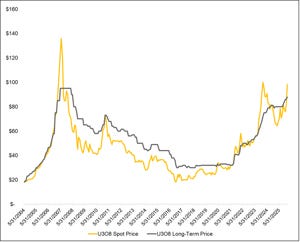
Uranium price chart
Spot: Trading Economics reports uranium at 85.80 dollars per pound on April 8, up 0.76 percent day over day, down just 0.12 percent over the past month, but 33.23 percent higher than a year ago. Investing News Network’s live chart places spot around 85.17 dollars per pound this morning, after the first quarter saw a move from just above 80 dollars at the start of January to a 101.41 dollars per pound peak on January 29, followed by a pullback to the low 80s into quarter end. The American Nuclear Society recently noted that the March 31 price of 84.25 dollars per pound, down from 94.28 at January 31, still represents a high plateau compared with 2025 levels.
Futures: April 2026 futures (UXJ26) show a one month low of 83.50 dollars on March 23 and a one month high of 86.50 dollars on March 17, with performance down just 0.50 dollars, or 0.58 percent, since March 9, while up 2.10 dollars, or 2.52 percent, since January 9 and 16.35 dollars, or 23.68 percent, since April 9, 2025. June 2026 futures (UXM26) recently printed around 86.05 dollars, indicating a slightly upward sloping front of the curve with no evidence of stress.
Macro context: YCharts’ February average spot price of 71.30 dollars per pound, up from 69.71 in January and 54.32 a year earlier, underscores a 31.27 percent year over yearstructural repricing of uranium. Sprott’s “Uranium Enters 2026” analysis shows spot and long term prices breaking decisively out of their 2010s range, with long term contracts in the 75 to 85 dollar per pound band that can support continued mine sanctioning and an extended bull market. CarbonCredits’ April 6 review stresses that global spot around 84 dollars per pound reflects seasonal consolidation on top of “exceptionally tight” fundamentals, as secondary inventories draw down and mine bottlenecks clash with sharply higher power demand from AI and new reactors.
5. SEQH Desk View
Today’s tape is more rotation than reversal. Uranium at 85.80 dollars per pound, down basically flat on a one month view and still more than 33 percent higher year over year, fits a commodity consolidating a large January spike, not one breaking lower. Against that backdrop, the market chose to sell some of yesterday’s winners, specifically CCJ, LEU, Oklo, TLN, NNE, SMR, ASPI, BWXT, CEG, VST, while buying BE, NUAI, URG, EU, DNN and a few micro caps.
The key signal is that the long term uranium and nuclear thesis remains firmly intact across all three pillars:
Price deck: Spot and futures are stable in the mid 80s, with long term contracts in the 75 to 85 dollar range, and the first quarter confirmed a new structural plateau compared with 2025.
Projects and earnings: The Phoenix in situ recovery project final investment decision at Denison, LEU’s high assay low enriched uranium build out, BWXT’s approximately 7.3 billion dollar backlog, and UEC’s strong second quarter margins all point to continued capital formation across the fuel cycle.
Demand narrative: AI and data center driven power demand and national energy security policies are consistently highlighted in mainstream coverage as reasons why CEG, BWXT, and other nuclear linked names could be among the most compelling energy buys of 2026.
For positioning, today looks like an opportunity to add incrementally to the quality core on weakness, particularly CCJ, UEC, LEU, DNN, UUUU, UROY, BWXT, CEG, VST, TLN, while remembering that BE, NUAI, Oklo, SMR, NNE, ASPI sit firmly in the high beta, narrative heavy bucket. Those can be powerful tools, but they should be used as tactical satellites, not as the backbone of the book.
6. Q2 and Easter Promo - 20 Percent Off Yearly Paid Substack Membership (For Life)
To mark the start of the second quarter and the Easter holiday, SEQH Capital Research is offering 20 percent off our yearly paid Substack membership, locked in for life.
Discount: 20 percent off the standard yearly rate
Lock in: Your discounted rate is guaranteed for as long as your yearly subscription stays active
What you get:
Full nuclear and uranium sector coverage, including daily and weekly recaps, deep dives, and tear sheets
Real time desk notes on positioning, catalysts, and risk management
Model portfolio updates, entry and exit bands, and scenario work across the uranium and nuclear stack
To claim the offer, upgrade to a yearly paid membership on our Substack checkout page during the Q2 and Easter promo window. The discount will auto apply and remain in place for the life of your subscription.
PROMOTION LINK HERE