

SEQH Capital Partners Research
Market Recap – October 28, 2025
SUMMARY
Today’s U.S. equities market reached historic highs, with the S&P 500 closing above 6,800 for the first time. Gains were driven by technology megacaps and a decisive rally in nuclear and uranium-related equities, as investors responded to a major U.S. government initiative to build $80 billion in new nuclear reactors.
MACRO MARKET DEVELOPMENTS
S&P 500 closed at 6,875.17, setting a new record and pushing year-to-date returns decisively into double digits.
Tech sector leadership continued, as Apple’s market cap breached $4 trillion and semiconductors outperformed, propelled by AI-infrastructure spending and improved U.S.-China trade outlook.
10-year Treasury yield retreated to 4.00%, reflecting investor anticipation of a 25 bp rate cut at tomorrow’s FOMC meeting.
Commodities markets showed mixed moves: WTI crude –2.19%, gold was modestly lower, and Bitcoin gave back gains, down 0.66% on risk-off flows.
The VIX Index declined 4%, with volatility receding on confidence in Fed policy signals.
NUCLEAR & URANIUM SECTOR HIGHLIGHTS
The Biden administration announced a $80 billion pact to accelerate construction of advanced nuclear reactors, establishing Westinghouse AP1000 technology as a template for next-gen U.S. projects.
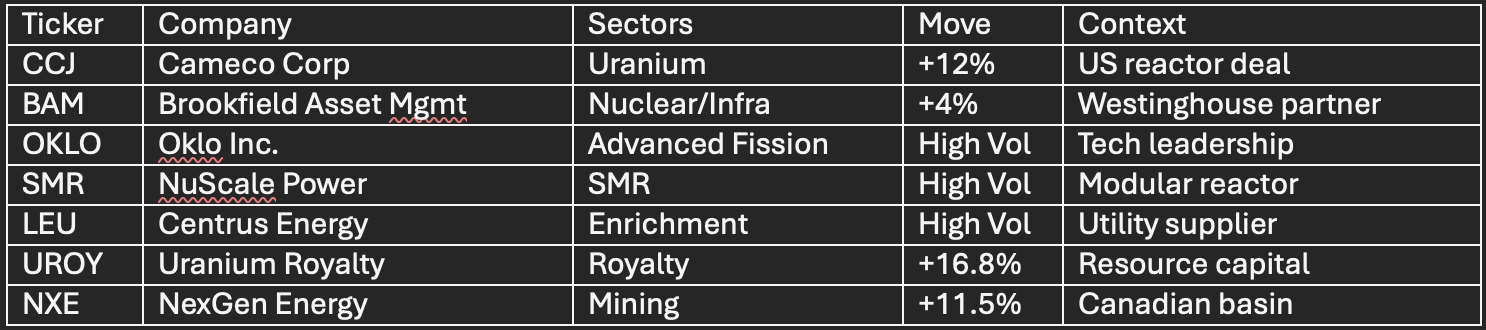
Cameco stock jumped 12%, while Brookfield and a wide array of uranium miners posted double-digit gains on a surge in sector optimism.
Uranium spot price advanced to $78.90/lb (+1.61%), snapping a multi-week consolidation phase amid renewed supply tightness and utility buying interest.
The Nuclear Energy Index rose 9.08% on the session, with leading equities such as Oklo, NuScale, Centrus, and Uranium Royalty outperforming broader benchmarks.
KEY TICKERS
STRATEGIC OUTLOOK
Rapid policy action and capital investment have solidified nuclear and uranium’s position as core growth sectors, with upside for equities and spot uranium pricing as supply constraints intensify and utility demand surges. Short-term volatility may persist, but sector dynamics now favor sustained outperformance.