

Market Recap: October 14, 2025
Executive Summary
Tuesday’s trading session reflected the persistent volatility that has characterized markets since escalating US-China trade tensions reignited in mid-October. Despite initial optimism from Monday’s rebound, markets closed mixed as new tariff threats and retaliatory measures overshadowed robust bank earnings that kicked off Q3 earnings season.
Major Index Performance
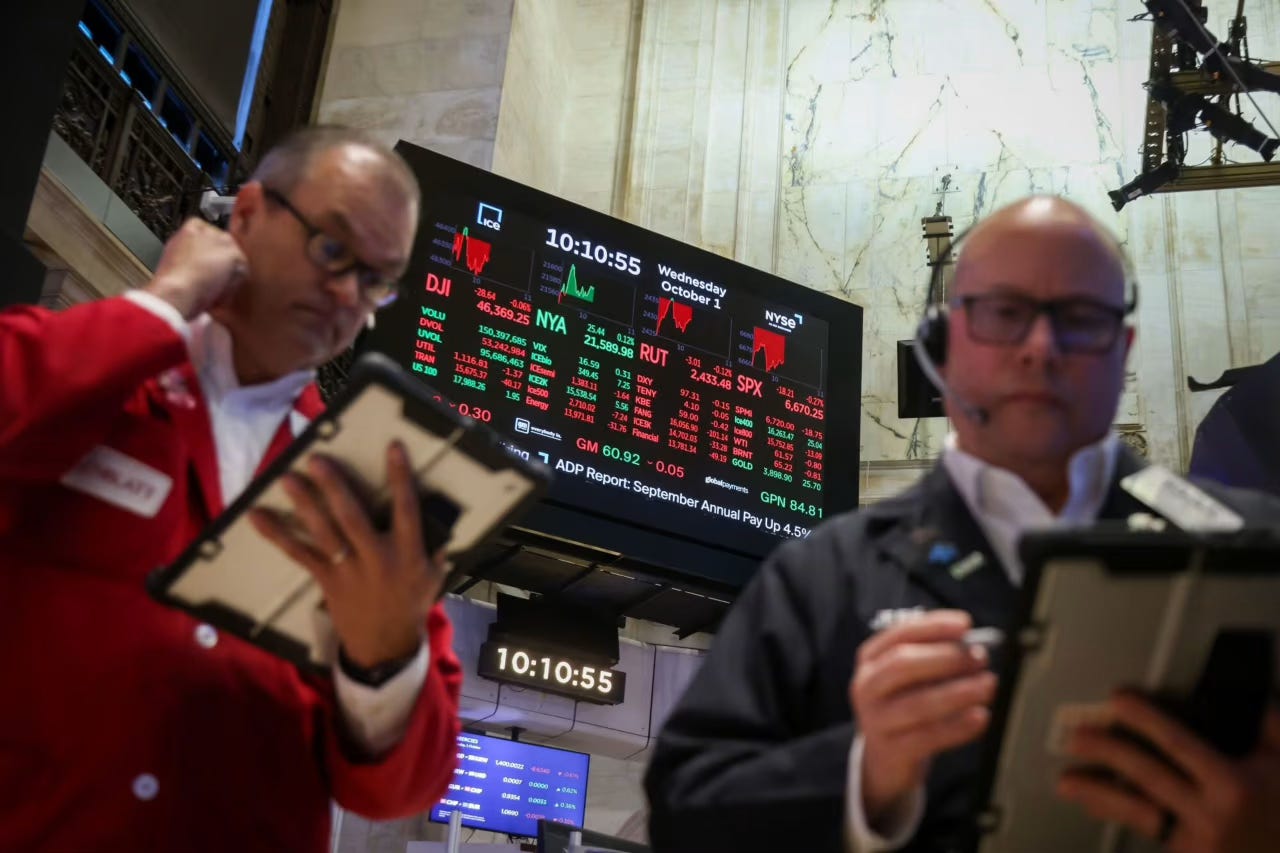
The session showcased divergent sector performance with significant dispersion across major indices. The Dow Jones Industrial Average managed a 0.4% gain to close at 46,269.46, buoyed by strong financial sector performance. However, the S&P 500 declined 0.2% to 6,644.31, reflecting pressure from technology and growth-sensitive sectors. The tech-heavy Nasdaq Composite experienced the steepest decline, falling 0.8% to 22,521.70 as semiconductor and AI-related stocks faced selling pressure.
The small-cap Russell 2000 bucked the broader weakness, advancing 1.4% to 2,495.50, suggesting investors maintained appetite for domestic-focused companies despite trade uncertainties. This performance pattern reflected a classic risk-off rotation as markets processed geopolitical developments.
Trade War Escalation Impact
The session’s primary catalyst was the escalation of US-China trade tensions, which dominated headlines and drove risk-off sentiment across global markets. Beijing implemented immediate sanctions against five US subsidiaries of South Korean shipbuilder Hanwha Ocean, effectively prohibiting Chinese entities from conducting business with these firms. This retaliatory action followed the US Trade Representative’s Section 301 investigation into China’s maritime dominance.
Simultaneously, both nations imposed reciprocal port fees targeting each other’s vessels, with China’s fees starting at 400 yuan ($56) per net ton and escalating to 1,120 yuan by April 2028. The measures represented a significant escalation beyond rare earth export restrictions announced the previous week.
President Trump’s late-session Truth Social post further dampened sentiment, where he accused China of “intentionally not purchasing” US soybeans and threatened potential termination of cooking oil trade relations. This rhetoric contributed to the afternoon selloff that erased earlier gains.
Banking Sector Earnings Excellence
The financial sector provided a significant bright spot with major banks delivering exceptional Q3 results that exceeded analyst expectations across all key metrics.
JPMorgan Chase reported stellar performance with earnings per share of $5.07 versus expected $4.84, driven by record trading revenue of $8.9 billion and 16% growth in investment banking fees. Net income surged 12% to $14.4 billion while revenue climbed 9% to $47.1 billion. The bank raised its full-year net interest income forecast to approximately $95.5 billion, citing strong balance sheet growth and continued economic resilience.
Wells Fargo emerged as the session’s standout performer with shares surging nearly 9% to $85.98, approaching record highs. The bank reported EPS of $1.66 versus expected $1.55, with revenue climbing 5.3% to $21.44 billion. Management raised their return on tangible common equity target to 17-18% from 15%, signaling confidence following the removal of the Federal Reserve’s asset cap in June.
Goldman Sachs delivered strong results with a 37% jump in profits to $4.1 billion, though shares declined nearly 5% as investors took profits after recent gains.
Nuclear Sector Momentum
The nuclear energy sector continued its remarkable 2025 performance with the Nuclear Energy Index climbing 3.0% to 57.94, extending its year-to-date gain to an impressive 90.65%. This marked another 13.5-year high for the sector, driven by mounting evidence of accelerating demand for clean baseload power.
Oklo (OKLO) advanced 6.4% as investors responded positively to the company’s selection for a second DOE pilot program and Canaccord Genuity’s initiation with a buy rating and $175 price target. The company’s participation in the Advanced Nuclear Fuel Line Pilot Project reinforces its position in next-generation reactor development.
Nano Nuclear Energy (NNE) surged 4.76% to $54.44 following breakthrough announcements in nuclear fusion technology and continued progress on micro reactor development. With approximately $600 million in cash following recent financing, the company maintains substantial runway for development activities.
ASP Isotopes (ASPI) announced commencement of an underwritten public offering, reflecting continued investor demand for uranium enrichment and isotope production capabilities. The broader uranium market showed strength with prices hovering near $79.15 per pound, up 5.18% over the past month despite being 4.58% below year-ago levels.
Healthcare Sector Developments
Healthcare demonstrated resilience with Johnson & Johnson reporting solid Q3 results despite shares declining 0.8% in pre-market trading. The company delivered EPS of $2.80 versus expected $2.76, with revenue of $24.0 billion representing 6.8% growth. Management raised full-year sales guidance to $93.7 billion and announced plans to separate its DePuy Synthes orthopedics business into a standalone entity.
The biotech subsector showed mixed performance with key M&A activity driving investor interest. BioCryst Pharmaceuticals announced acquisition of Astria Therapeutics in a $700 million cash-and-stock deal focused on hereditary angioedema treatments. Meanwhile, Kailera Therapeuticsraised $600 million in one of the year’s largest private biotech financings, targeting obesity drug development.
Metals and Mining Surge
Rare earth and critical metals companies experienced explosive gains as trade tensions highlighted supply chain vulnerabilities. Critical Metals rocketed over 1,000% year-to-date, gaining an additional 27% in pre-market trading Tuesday following Monday’s 55% surge. The company’s remarkable performance reflects both speculative interest and legitimate concerns about rare earth supply security.
United States Antimony gained 14% in pre-market trading while Energy Fuels rose 11%. These moves followed China’s announcement of expanded rare earth export controls covering 12 of the 17 rare earth metals, effective December 1st.
Gold continued its historic rally, with spot prices surging through $4,100 per ounce for the first time in history, up 2.2% on the session. The precious metal’s relentless advance reflected heightened geopolitical uncertainty, safe-haven demand, and expectations for continued Federal Reserve rate cuts.
Cryptocurrency Market Weakness
Bitcoin and the broader cryptocurrency market faced selling pressure as risk-off sentiment dominated. Bitcoin declined 1.4% to $113,144, testing key support at the $110,000 level. The total cryptocurrency market capitalization slipped below $4 trillion to $3.97 trillion, with nine of the top ten coins posting losses.
Solana provided the lone bright spot among major cryptocurrencies, gaining 4.1% to $202 as institutional adoption narratives continued to support the ecosystem. The weakness reflected broader risk asset selling amid trade tensions and uncertainty surrounding Federal Reserve policy normalization.
Federal Reserve Policy Outlook
Fed Chair Jerome Powell’s afternoon speech at the NABE conference provided modest market support, reaffirming the central bank’s commitment to data-dependent policy normalization. Powell indicated that “downside risks to employment have shifted our assessment of the balance of risks,” suggesting continued accommodation despite tariff-driven inflation pressures.
The Fed’s preferred inflation measure has risen to 2.9% due to tariff impacts, though Powell emphasized that “broader inflationary pressures” remain contained outside of trade-related effects. Markets maintained near-certainty for a 25 basis point rate cut at the October 29 meeting, with Fed funds futures pricing in a 97.8% probability.
Volatility and Risk Metrics
The CBOE Volatility Index (VIX) surged to 22.94 during intraday trading, reaching its highest level since May 23rd before settling at 19.68. The spike reflected underlying market anxiety despite relatively modest index moves, as options demand surged amid trade uncertainty.
The elevated VIX reading above 20 typically indicates heightened demand for portfolio protection, signaling that institutional investors are positioning defensively despite continued optimism about economic fundamentals.
Looking Ahead
The confluence of accelerating earnings season, ongoing trade negotiations, and Federal Reserve policy decisions creates a complex backdrop for markets as Q4 unfolds. While banking sector strength demonstrates underlying economic resilience, geopolitical tensions and sector rotation patterns suggest continued volatility ahead.
Key catalysts for the remainder of October include the Fed’s October 29 policy meeting, ongoing US-China trade negotiations, and the continuation of Q3 earnings reports across major sectors. The nuclear energy sector’s momentum appears sustainable given growing institutional recognition of baseload power requirements, while metals markets remain highly sensitive to trade policy developments.
The market’s ability to navigate these crosscurrents while maintaining recent highs will likely depend on the trajectory of trade talks and the Fed’s policy normalization path, making tactical positioning and risk management increasingly critical for the weeks ahead.