

SEQH Capital Research · Wednesday, November 25, 2026 · Research only: no ratings, price targets or recommendations.
Two deals, six weeks apart
On November 10, Fermi America signed an agreement with an unnamed investment-grade hyperscaler for about 600 MW of power at its Texas campus. The Financial Times later reported the customer is Amazon. The deal came with a $200 million prepayment agreement and a jump in the stock. In Fermi’s own words, it is also a non-binding letter of intent. The company’s 10-Q states that it has “not entered into definitive lease agreements with any tenants,” and that there is “no guarantee” one will be signed.
Six weeks earlier, on September 30, Fervo Energy’s first 33 MW block in Utah entered commercial operation, ahead of its contract date. It delivers under a 15-year take-or-pay contract with Google for 396 MW, the kind of contract lenders write checks against.
Both get filed under “AI power deal.” They are not the same thing, and the gap between them is where most of the risk in this sector now sits.
So we took our AI power deal tracker, 22.5 GW of agreements signed by Amazon, Meta, Google and Microsoft, and graded it the way we grade a deal for a client. For each deal we asked three questions. Is it signed? Is it financed? Is it licensed? Then we asked a fourth: when does the power actually show up?
The headline number, broken down
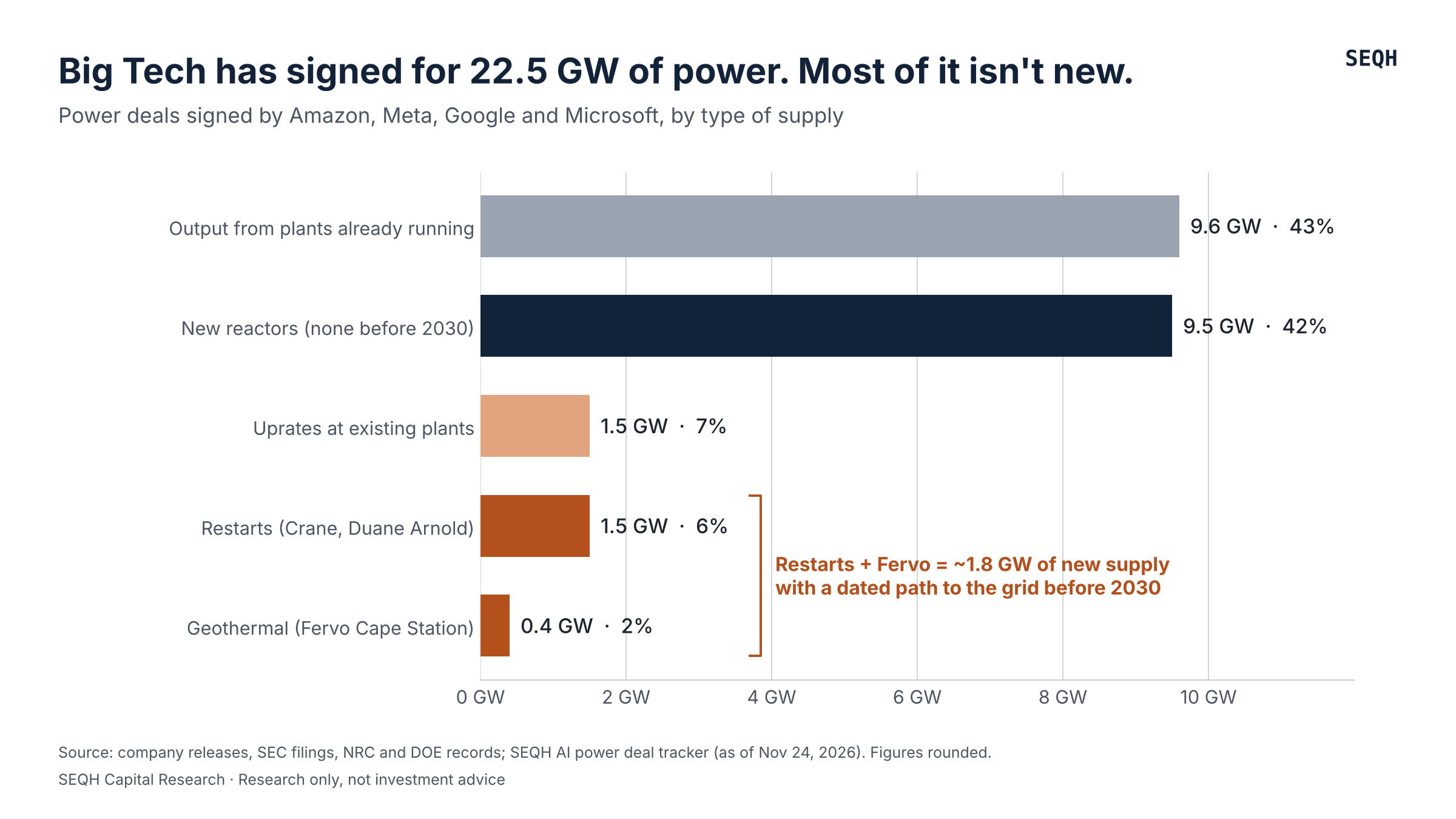
The 22.5 GW comes in five very different kinds of deal:
Output from plants already running: 9.6 GW (43%). Long-term contracts for power from existing nuclear plants. This includes Meta’s 2,176 MW from Vistra’s Perry and Davis-Besse plants, Google’s 2,700 MW 15-year deal across Constellation’s PJM fleet, and Amazon’s 1,920 MW from Talen’s Susquehanna.
New reactors: 9.5 GW (42%). Amazon–X-energy (5 GW), Meta–TerraPower (up to eight Natrium units), Meta–Oklo (1.2 GW) and Google–Kairos (500 MW).
Restarts: 1.5 GW (6%). Microsoft’s Crane (835 MW) and Google’s Duane Arnold (615 MW).
Uprates at existing plants: 1.5 GW (7%). Google–Constellation (890 MW), Meta–Vistra (433 MW) and Amazon–Calvert Cliffs (190 MW).
Geothermal: 0.4 GW (2%). Google–Fervo, 396 MW.
The first bucket is real, signed and largely delivering. It adds no new electrons to the grid: it moves existing output under a long-term contract to a new buyer. The second bucket is the largest pile of “new” capacity, and none of it arrives before 2030. The new supply that can arrive sooner is the small stuff in the middle: restarts, uprates and geothermal, together 3.4 GW.
The near-term supply, graded deal by deal
Crane Clean Energy Center (Microsoft, 835 MW)
Signed: yes, a 20-year PPA.
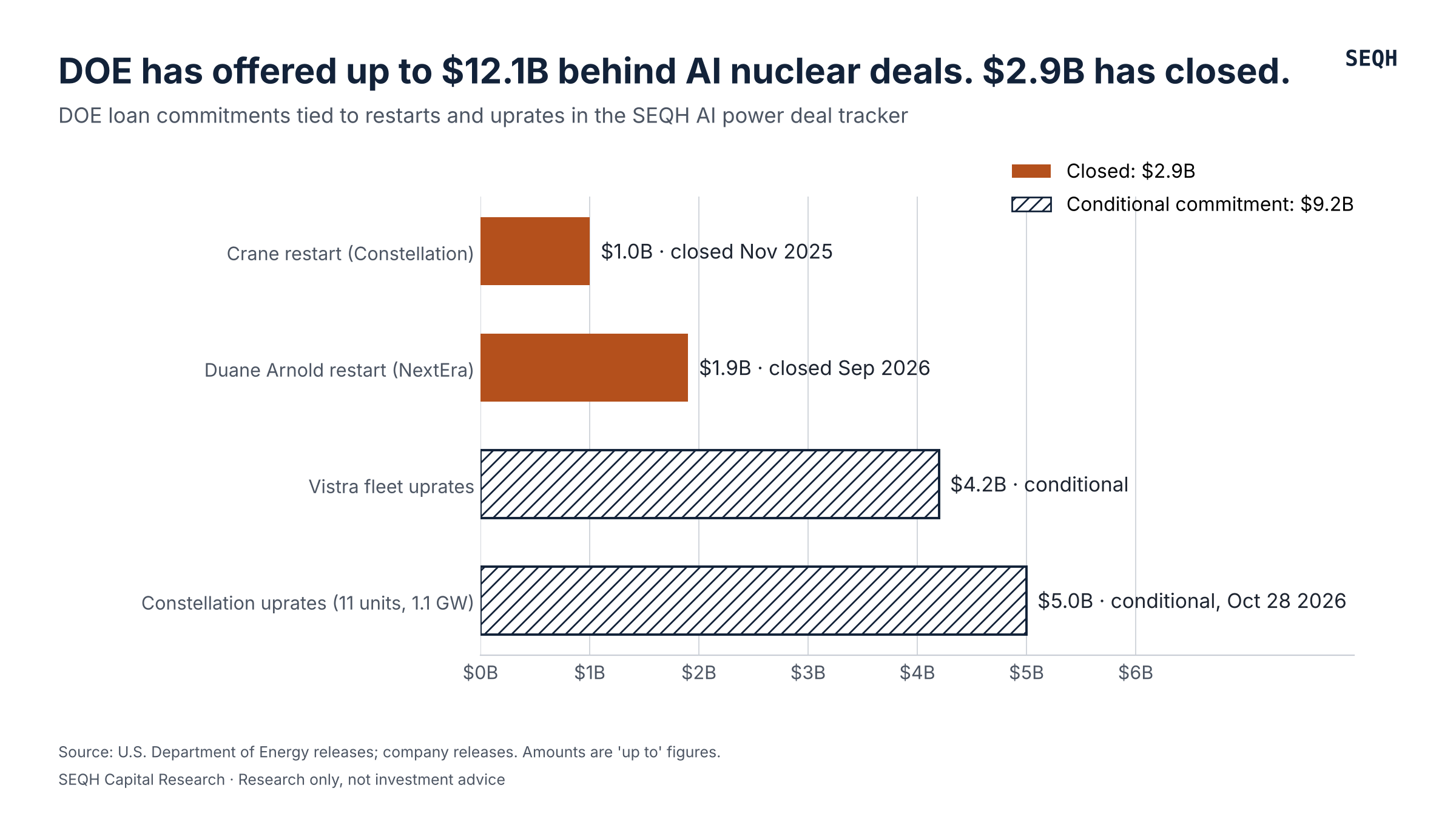
Financed: yes. DOE closed a $1 billion loan in November 2025.
Licensed: in progress. The NRC has approved on-site storage of new fuel while it reviews the restart, and FERC granted a waiver that eases reconnection to the grid.
Power: Constellation targets 2027, a year ahead of its original 2028 plan.
Our read: the most advanced deal in the tracker. Signed, financed and targeting 2027. What’s left is the NRC’s final approval to restart.
Duane Arnold (Google, 615 MW)
Signed: yes, a 25-year PPA.
Financed: yes. DOE closed a loan of up to $1.9 billion in September 2026.
Licensed: in progress. The NRC issued a draft environmental assessment and a finding of no significant impact in August; the final version was expected this fall.
Power: NextEra targets Q1 2029.
Our read: contracted and financed. Like Crane, the gate that’s left is the NRC.
Cape Station Phase II (Google, 396 MW geothermal)
Signed: yes, 15-year take-or-pay.
Financed: in part. Phase I closed $421 million of non-recourse debt in March, but Phase II’s roughly $2.2 billion build has no project debt announced yet.
Built: drilling is about 18% complete and the first turbine set has passed factory testing.
Power: first power mid-2028, full capacity by the end of 2028.
Constellation uprates (Google 890 MW, Amazon 190 MW)
Signed: yes. Google’s uprate PPA is 20 years and Amazon’s Calvert Cliffs deal is 20 years.
Financed: Constellation expects to spend more than $4.3 billion on Google’s uprates. DOE offered a $5 billion conditional loan on October 28 for 11 uprates totaling 1.1 GW, not yet finalized.
Licensed: each uprate needs NRC approval.
Power: Google’s first wave in 2028. Calvert Cliffs between 2030 and 2032.
Vistra uprates (Meta, 433 MW)
Signed: yes, part of Meta’s 20-year PPAs for more than 2,600 MW.
Financed: a DOE conditional commitment of up to $4.2 billion for Vistra’s fleet.
Power: capacity added through 2034.
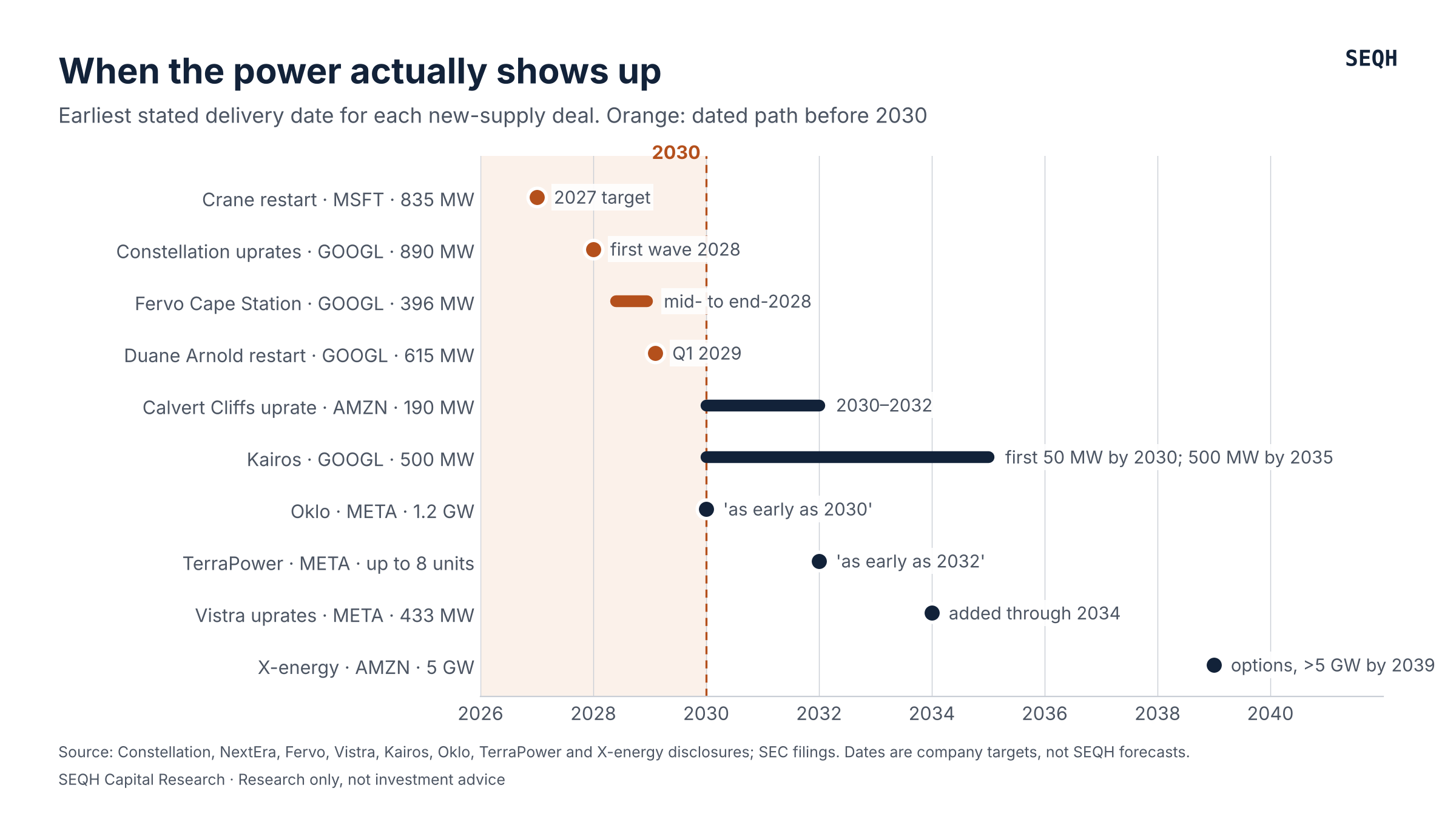
Add it up. The two restarts plus Fervo come to about 1.8 GW of new supply with a dated path to the grid before 2030, about 8% of the headline 22.5 GW. Constellation’s first uprates add to that from 2028. Everything else that is new arrives in the 2030s.
One more number worth sitting with: the four DOE loan commitments behind these deals total up to $12.1 billion. $2.9 billion has closed, all of it for the two restarts. The $9.2 billion for uprates is still conditional.
The new reactors: options, not obligations
The new-reactor deals look different once you read the terms.
Amazon–X-energy (5 GW). X-energy’s IPO prospectus describes “options” to bring more than 5 GW online by 2039. The first project, with Energy Northwest, is four reactors totaling 320 MW, expandable to 960 MW. Its permit status isn’t stated. X-energy’s furthest-along project is for Dow in Texas, not Amazon: its construction permit decision is expected in Q1 2027.
Meta–TerraPower (up to eight units). Meta supports early development of the first two units and holds rights to power from up to six more. No site has been chosen. First power is “as early as 2032.” TerraPower’s own Kemmerer reactor, which has nothing to do with Meta, received its construction permit in March and broke ground in April.
Meta–Oklo (1.2 GW, Pike County, Ohio). First power “as early as 2030.” Funding terms are not disclosed.
Google–Kairos (500 MW by 2035). The furthest along of the four. Hermes 2, a 50 MW plant for Google via TVA, broke ground in April, with operations expected by 2030.
None of this means these reactors won’t be built. It means the buyer’s commitment today is mostly an option on future output, and the developer carries the cost, licensing and schedule risk until the plant runs. A headline GW figure prices that option as if it were power.
The commercial read
1. The money in “AI nuclear” today is in contracts on existing plants. Nearly half the tracker is existing output signed to long-term contracts. For the owners, Constellation, Vistra and Talen, that is real: 15- to 20-year contracts with investment-grade buyers turn merchant power plants into something closer to infrastructure. But it adds no supply. Even Talen’s 1,920 MW to Amazon ramps up and won’t reach full volume until 2032.
2. The new supply arriving before 2030 is small and backed by government loans. Restarts and uprates are the cheapest, fastest new megawatts in the U.S. They are also capped: there are only so many closed plants to restart and so much headroom in existing reactors. The DOE’s lending is doing a lot of the work. Up to $12.1 billion has been offered. The restarts’ $2.9 billion has closed; the uprates’ $9.2 billion hasn’t.
3. Before 2030, data-center load runs on gas and the grid. That’s why Fermi’s campus is built around gas turbines, with nuclear as a 2034-and-later plan. It’s also why Fervo’s on-time delivery matters beyond geothermal: it’s one of very few firm, clean megawatts that can arrive this decade at scale.
4. For investors, the useful question is “signed what?” A take-or-pay PPA with a hyperscaler can be financed. A letter of intent, an option or a framework agreement cannot. The market has treated all of them as “AI power deals.” In the selloff last week and the rebound on Monday, AI-linked power names moved like AI stocks. That points to the market pricing the headline, not the paperwork.
What would change our read
Crane’s NRC restart approval. The first new nuclear electrons in this tracker, and a test of how fast restarts can move.
DOE closing the conditional loans. If Constellation’s $5 billion and Vistra’s $4.2 billion close, the uprate pipeline is effectively funded.
A firm order behind an option. A construction permit, a final investment decision or a binding PPA on any of the new-reactor deals, especially the first Energy Northwest units for Amazon.
Phase II financing at Cape Station. Project debt for the $2.2 billion build would show lenders will back geothermal at scale.
Fermi’s lease. Whether the 600 MW letter of intent becomes a lease by December 31, when Texas Tech’s notice-to-proceed deadline hits.
SEQH Capital Research publishes research for informational and educational purposes only. Nothing here is investment advice, a rating or a price target. Figures as of November 24, 2026, from company releases, SEC filings, NRC and DOE records, and the SEQH AI power deal tracker.