


ASP Isotopes Inc. (ASPI) - Unit Economics Reality Check
SEQH Capital Research
November 2, 2025
Executive Summary: Where’s the Revenue?
ASPI doesn’t break out unit economics by business line in SEC filings, only consolidated numbers with vague segment labels. After digging through every 10-Q, 10-K, and press release, here’s what the numbers actually show versus what management promotes.
The Bottom Line: FY 2024 revenue was $4.1M, with essentially all of it from PET Labs radiopharmacy operations, not the proprietary isotope technology justifying the $1B+ valuation. The company burns ~$80M annually while touting contracts worth hundreds of millions that haven’t generated meaningful revenue yet.
Actual Financial Performance (Not the Press Release Version)
Consolidated Results - Q2 2025 (Most Recent Quarter)
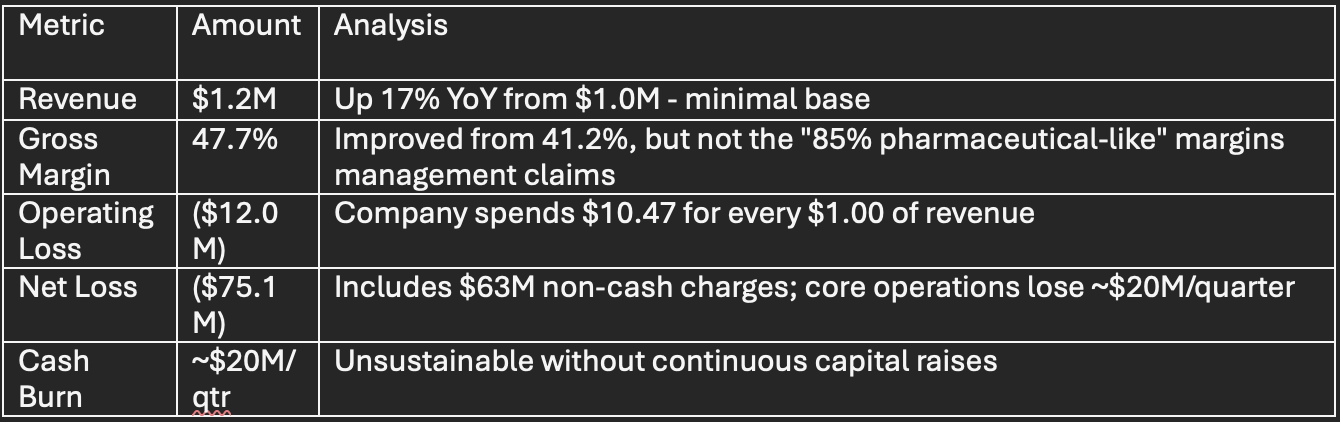
Source: ASPI 10-Q filed Aug 14, 2025
Full Year Results Comparison

Source: ASPI 10-K filed March 30, 2025; ASPI investor relations income statement
The 857% revenue “growth” sounds impressive until you realize it’s growing from an absurdly low base. More importantly, losses expanded faster than revenue.
Business-by-Business Reality Check
Since ASPI won’t provide this breakdown in audited financials, here’s what you can piece together from press releases and SEC filings:
1. PET Labs (Radiopharmaceuticals) - The Only Real Revenue
FY 2024 Revenue: ~$4.2M
Gross Margin: Likely 39-48% (consolidated company margin)
Status: Operational and stable
Reality: This IS the current business. Everything else is pre-revenue or minimal.
Source: ASPI Q2 2025 10-Q; management business updates
2. Molybdenum-100 - Zero Revenue Despite 3-Year-Old Contract
Contract Announced: November 2022 with BRICEM (Beijing Research Institute)
Projected Revenue: $2.5M to $27M per annum (25-year term)
Claimed Margin: ~85% “pharmaceutical-like”
Actual Revenue to Date: $0
Issue: Production delayed due to “feedstock supply complications”
Source: ASPI press release Nov 28, 2022; Q2 2025 business updates
Translation: Management announced a blockbuster contract three years ago. Still hasn’t shipped product. This should concern you.
3. Carbon-14 - Just Started Production (Finally)
Contract: Take-or-pay with RC-14 Inc. for minimum $2.4M annually
Claimed Margin: ~85%
Production Start: February 2025 (delayed from 2024 guidance)
H1 2025 Revenue: Minimal contribution, not separately disclosed
Reality: Too early to assess actual unit economics
Source: ASPI press release Feb 25, 2025; Q2 2025 10-Q
4. Silicon-28 - High Price, Low Volume, Uncertain Scaling
Pricing: $550,000 per kilogram (small research volumes)
Capacity: 50+ kg/year
Claimed Margin: ~75%
Current Status: Pre-revenue at commercial scale
Issue: $550K/kg pricing only works for research. Commercial pricing needs to be “significantly lower” per management.
Translation: The per-kg price sounds amazing, but it’s not a viable commercial model. Full capacity at current pricing = $27.5M revenue, but they’ve said that pricing doesn’t scale.
5. HALEU (Nuclear Fuel) - Pure Speculation
Projected Revenue: $375M potential (TerraPower contract)
Projected Margin: 40-63% depending on feedstock
Plant Cost: <$100M per facility
Target Timeline: 2027
Current Status: Zero revenue, licensing not obtained
Reality: Entire business is 2027-2030 projections, not demonstrated economics
Source: ASPI investor presentations; TerraPower agreement disclosures
6. Renergen Merger - Combining Two Loss-Making Companies
Renergen FY2025 Revenue: ~$700K (minimal)
ASPI Equity Raise for Deal: $210M (September 2025)
Pro Forma Combined Revenue: ~$7M (both companies early-stage)
Pro Forma Combined Loss: ~$48M annually
Management 2030 Target: >$300M EBITDA
Reality: Both companies currently unprofitable; 2030 target requires 43x revenue growth
Source: Renergen scheme circular June 2025; ASPI 8-K filings May-Aug 2025
The “Energy Cost Savings” Story: Management claims Renergen LNG can reduce isotope production energy costs by 94%. That’s material if true (energy = 90% of COGS), but it’s forward-looking integration economics, not current reality.
7. Quantum Leap Energy (Nuclear Waste) - 3-4 Years From Revenue
Upfront Cost: $3M ($150K cash + 266K shares)
Development Spend: $4.5M Mini Unit, $12.5M Midi/Maxi Unit
Revenue Model: 6% royalty on net revenues (15 years)
Timeline: 36 months to commercial validation
Reality: Development stage, no near-term revenue
Source: ASPI 8-K filed Oct 22, 2025; QLE acquisition press release
The Unit Economics Problem: What You Can’t Find
Data NOT Disclosed in SEC Filings:
Revenue by product (only two vague segments: “Specialist Isotopes” 95%, “Nuclear Fuels” 5%)
Production costs per kilogram by isotope type
Actual production volumes vs. nameplate capacity
Plant utilization rates
Product-specific gross margins
Contractual minimum volumes (vs. maximum potential)
Per-plant profitability
Where Unit Economics Data Appears:
Contract maximums: Press releases (not binding minimums)
Margin estimates: Investor presentations (not audited P&Ls)
Pricing: Management statements (often small-volume research pricing)
Production targets: Forward-looking guidance (not achieved results)
Cost Structure: The Real Numbers
Q2 2025 Operating Expenses Breakdown

Source: ASPI Q2 2025 10-Q
The Math: ASPI generated $1.2M in revenue and spent $12.5M in operating expenses. SG&A alone is 973% of revenue—corporate overhead, M&A costs, and business development for a company generating less revenue than a mid-sized dentist’s office.
This cost structure only works if revenue scales dramatically. If it doesn’t, dilution accelerates.
Management Guidance vs. Actual Results
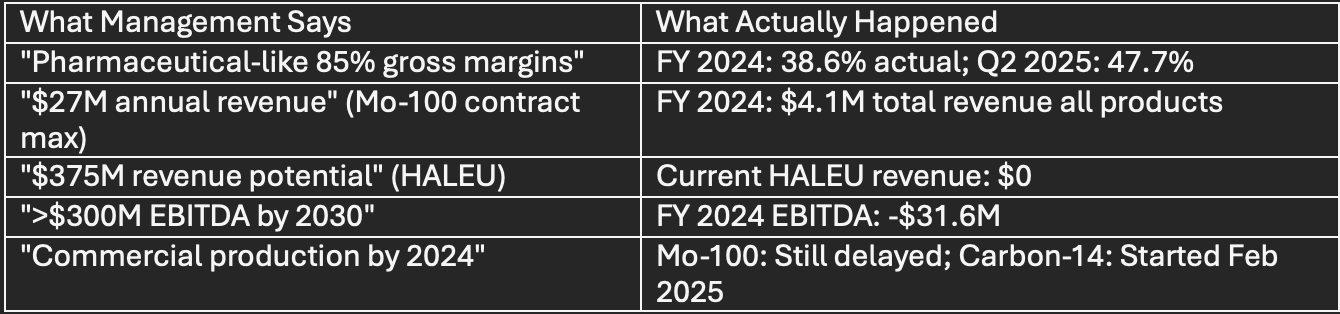
Sources: ASPI press releases 2022-2025; ASPI 10-K FY 2024
Investment Thesis: What You’re Actually Buying
Bear Case (What the current data shows):
Three years post-Mo-100 contract, zero revenue due to execution issues
FY 2024 revenue of $4.1M almost entirely from acquired radiopharmacy, not proprietary tech
$80M annual cash burn requires continuous dilutive capital raises
Forward projections consistently miss (production delays, timeline slippage)
Trading at 234x revenue with no clear path to profitability in next 2 years
What You’re Buying: A development-stage advanced materials company with unproven commercial-scale unit economics, trading on 2027-2030 projections rather than demonstrated profitability. This is a high-risk speculation on technology commercialization, not an investment backed by transparent, audited business-line economics.
Where to Find the Limited Data Available
Since ASPI doesn’t provide granular unit economics in SEC filings, you’re stuck with:
SEC EDGAR (sec.gov): Search “ASP Isotopes” for 10-Q and 10-K—consolidated financials only
Company IR (ir.aspisotopes.com): Press releases with contract announcements and forward guidance
Earnings Transcripts: Quarterly calls via SeekingAlpha or earnings.io for management commentary
Third-Party Research: Ocean Wall Partners, Blue Gem Research (Google for PDFs)
Bottom Line: You were right to be frustrated. ASPI provides “rosy stories for future rockstar profits” in press releases while actual audited unit economics by business line don’t exist in public filings. The company is pre-commercial for its core isotope technology, burning significant cash, and dependent on successful execution of 2027-2030 projections that have consistently slipped.
HOW OUR FIRM SEES IT: The SEQH Capital Bull Case
We acknowledge the bear case above. The near-term unit economics are indeed anemic. But we believe the market is underpricing ASPI’s embedded optionality and transformational margin expansion potential. Here’s our analytical framework:
