

Uranium Research Tear Sheet
November 2025 Update
Investment Thesis: Consolidation Presents Accumulation Opportunity
Uranium has entered a healthy consolidation phase following exceptional year-to-date gains (+14% spot, +49-56% ETF returns). Current spot pricing at $77.20/lb (down 3.4% from October) masks significant underlying strength: the long-term contract price indicator surged to $86.00/lb, the highest since 2007, reflecting utilities’ urgent need to lock in supply amid deepening deficits. The spot-to-term spread of $8.80/lb is historically elevated and signals that sophisticated institutional buyers view current prices as unsustainably low. We maintain BUY conviction with $80-$90/lb base case through 2027 and $120/lb bull case by 2028.
Market Dynamics: Spot Weakness Masks Term Strength
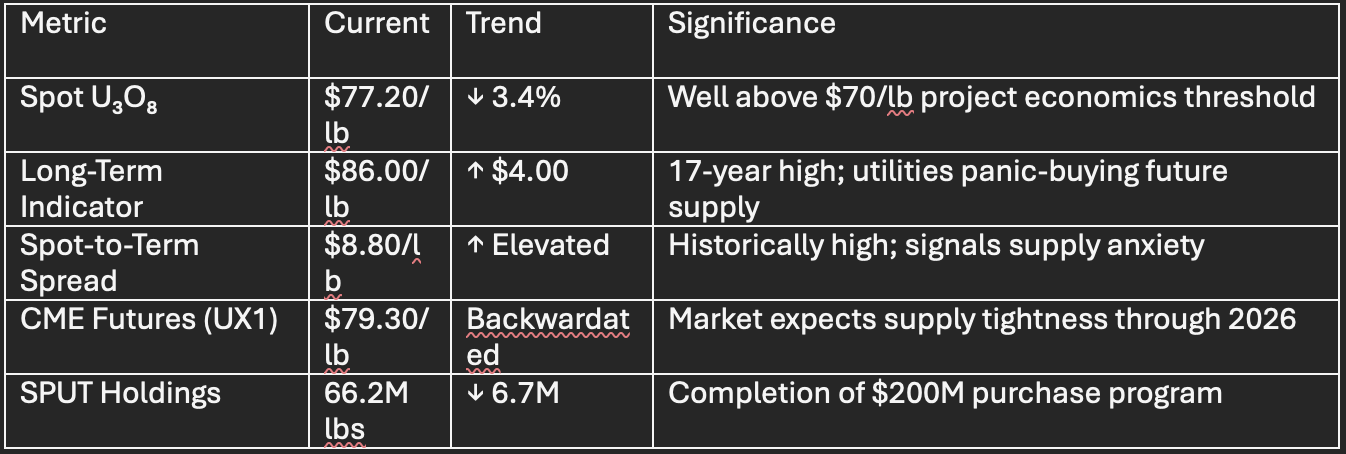
Key Insight: The divergence between spot and term pricing reflects textbook supply deficit dynamics, utilities are willing to pay substantial premiums for future certainty because they anticipate spot availability will deteriorate. This is precisely the pattern observed before uranium rallies to $90-$100/lb+.
Supply: Structural Deficit Accelerates
Kazatomprom (World’s Largest Producer):
2025 guidance: 25,000-26,500 tU (reaffirmed; on track for 18,700 tU through September)
2026 production cut: -10% to 29,697 tU (~7.8M lbs removed from market)
Rationale: “Value over volume” strategy; domestic nuclear development; acid availability optimization
Implication: Announced supply reduction at peak term prices signals producer confidence in sustained elevated pricing environment
Cameco (World’s Premier Western Producer):
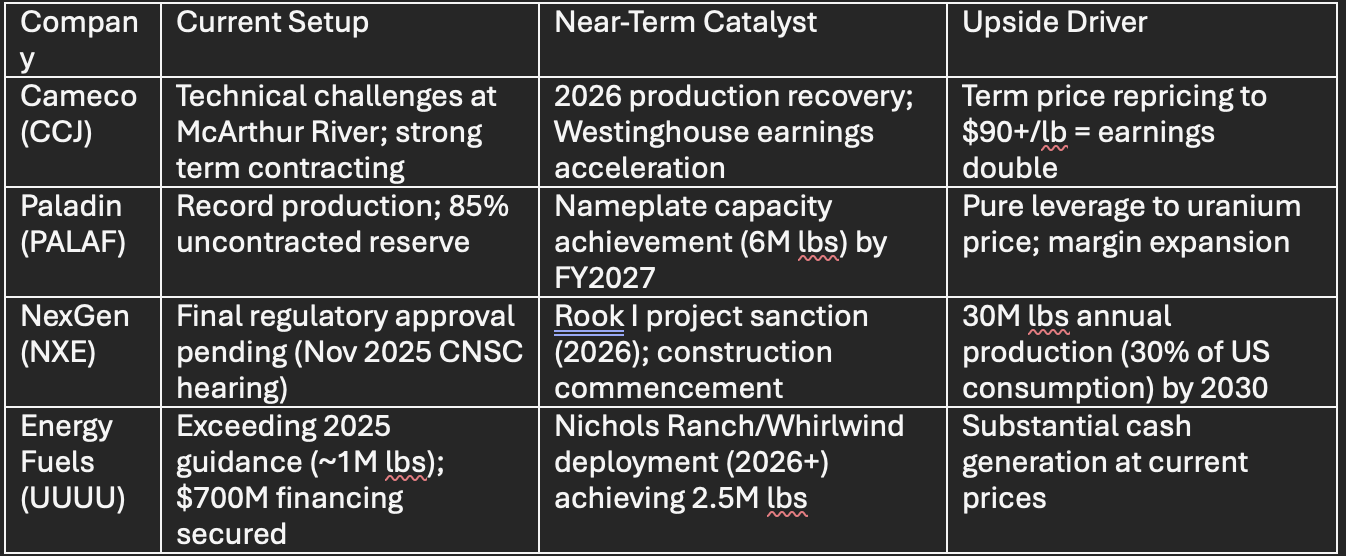
Q3 2025 production: 4.4M lbs (underperformed due to McArthur River technical challenges)
Revised 2025 guidance: “up to 20M lbs” (down from prior guidance; production volatility at Tier-1 assets)
Strategic positioning: Committing unencumbered capacity selectively at market-related pricing; positioned to capture upside as term contracts reprice
Westinghouse contribution: $569M adjusted EBITDA YTD (nearly 2x 2024 results); unique exposure to reactor construction boom
Paladin Energy (Restart Excellence):
Q1 FY2026 production: 1.07M lbs (+67% YoY; record quarterly output)
Trajectory: On track for 6M lb/year nameplate capacity by FY2027
Cost position: $41.6/lb all-in cost (healthy margins at $77/lb spot)
Uncontracted reserves: 85% of Langer Heinrich reserve available at market-related pricing
US Production Revival:
Energy Fuels 2025 guidance: ~1M lbs (on track to exceed; processing high-grade Pinyon Plain ore)
2026 potential: 2.5M lbs/year (contingent on Nichols Ranch and Whirlwind commissioning)
US production Q2 2025: 437K lbs (+41% YoY)
Strategic backdrop: Uranium designated Critical Mineral; fast-track permitting enabling; $1.4B strategic reserve allocation
Bottom Line: Global primary production (~145M lbs annually) faces reactor requirements exceeding 180M lbs, creating 35-40M lb structural deficit that must be filled through secondary inventory drawdowns. This ceiling on supply growth is incompatible with 1-2% annual consumption growth.
Demand: Multi-Year Structural Drivers
AI Data Centers (New Mega-Demand Vector):
Projected consumption by 2030: 945 TWh (equivalent to Japan’s entire electricity demand)
Data center power demand: Rising from 4% to 9-12% of total US consumption by 2030
Nuclear partnerships: $10B+ committed by Microsoft, Google, Amazon, Meta
Microsoft: 20-year PPA for Three Mile Island Unit 1 restart (835 MW; online 2028)
Amazon: 12 SMRs at Cascade facility (960 MW; targeting 2030s deployment)
Google-NextEra: Duane Arnold Energy Center restart (Iowa)
Uranium demand implications: Every 1 GW = 200 tons U₃O₈ annually; 22 GW of AI-nuclear projects = 11.4M lbs incremental demand (7% of global production)
Small Modular Reactors (Crystallizing Deployment):
NuScale: 6 GW TVA deployment (largest SMR program in US history; only NRC-certified design)
GE Hitachi BWRX-300: 2029 Ontario deployment; Clinch River (TVA), Rockport (Indiana) follow-on
Holtec SMR-300: 10 GW North America program; Palisades first unit
Timeline: 2029-2032 initial deployments; fleet replication model enables exponential growth 2030s+
Nuclear Reactor Restarts:
Japan: Kashiwazaki-Kariwa decision imminent (November 2025); potential +8 additional restarts in next 24 months = 1.2-2.0M lbs uranium demand
US: 7% nuclear capacity increase via restarts/upgrades targeted; Palisades (Michigan) path proven
Global: 72 reactors under construction; China adding 6-8/year targeting 200 GW by 2035
China & India Nuclear Mega-Expansion:
China 2025-2035: 140 GW new capacity = 28M lbs incremental annual uranium demand (40% of global production)
India 2025-2032: 13.6 GW new capacity = 2.7M lbs incremental annual uranium demand; longer-term 100 GW target by 2047
Strategic significance: Two countries totaling 3.4B people are simultaneously building nuclear capacity at unprecedented scale
Strategic Reserve Expansion:
US allocation: $1.4B committed for reserve expansion + domestic producer contracts
Demand floor: 5-10M lbs annually removed from market (price-inelastic government purchasing)
Allied coordination: EU, Canada, Australia pursuing coordinated stockpiling to reduce Russian dependence
Company Positioning & Stock Catalysts
Price Outlook & Catalysts
Base Case: $80-$90/lb through 2027
Q4 2025: $75-$82/lb consolidation
2026: $82-$90/lb (utility contracting resumes Q1; Chinese demand accelerates)
2027: $85-$95/lb (supply deficit intensifies; SMR deployments approach)
Trigger: Seasonal demand patterns; Kazatomprom production discipline realized; term premiums compress as spot climbs
Bull Case: $120/lb by 2028 (Upside Potential)
Kazatomprom 2026 cut sustained; supply disruption risk (mine outage, geopolitical); enrichment bottleneck acute
Scenario probability: 25-30% (up from 20% in October; fundamentals improving)
Bear Case: Sub-$60/lb (Low Probability)
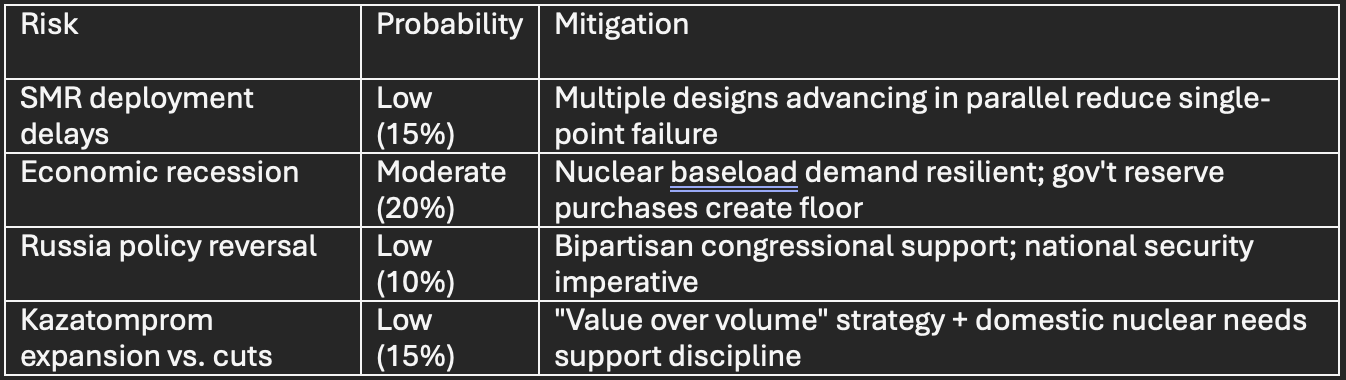
Requires: SMR delays 3-5 years + aggressive Kazatomprom expansion + Russian ban reversal + recession
Scenario probability: <15% (asymmetric risk-reward heavily favors upside)
Investment Recommendations
Allocation Strategy:
60-70% URNM (Sprott Uranium Miners ETF) – Pure mining exposure; outperforming during consolidation
20-30% URA (Global X Uranium ETF) – Diversified nuclear ecosystem; lower volatility
10-20% Individual Equities – Cameco (core leveraged position), Paladin (restart execution alpha)
Entry Thesis:
Current consolidation is tactical opportunity, not structural breakdown. Spot prices of $77/lb offer:
Limited downside: Only 15% to $65/lb (non-consensus estimate unlikely given supply floor/government demand)
Substantial upside: 25-55% to $95-120/lb over 24-36 months
Asymmetric risk-reward ratio of 1:3 to 1:5 supports accumulation
Key Monitoring Metrics:
Spot price $70-75/lb = aggressive accumulation zone
Term contract price trajectory (currently $86/lb; watch for $90/lb breakout)
SPUT premium/discount (currently -6%; watch for >8% discount = deeper value)
Utility contracting activity (2026 will be inflection year as supplies tighten)
Palisades/Three Mile Island restart execution (validates AI-nuclear thesis)
Risk Factors
Conclusion
The uranium market’s November consolidation represents strategic accumulation opportunity within a multi-year structural bull cycle, not the beginning of a downturn. The supply-demand fundamentals remain compelling: global primary production is structurally insufficient to meet reactor requirements, secondary inventories are finite and declining, and demand catalysts (AI, SMRs, restarts, strategic reserves) are accelerating faster than anticipated.
The long-term contract price at $86/lb signals utilities’ assessment that sustained deficits will persist through the decade. When spot prices eventually compress toward term prices (historical pattern in uranium cycles), investors positioned during the current consolidation will capture 25-55% upside to $95-120/lb within 24-36 months.
Rating: BUY | Target: $90/lb (2026), $110/lb (2027) | Time Horizon: 24-36 months
FULL 17-PAGE THEMATIC REPORT AND URANIUM UPDATED OUTLOOK ATTACHED BELOW:
