

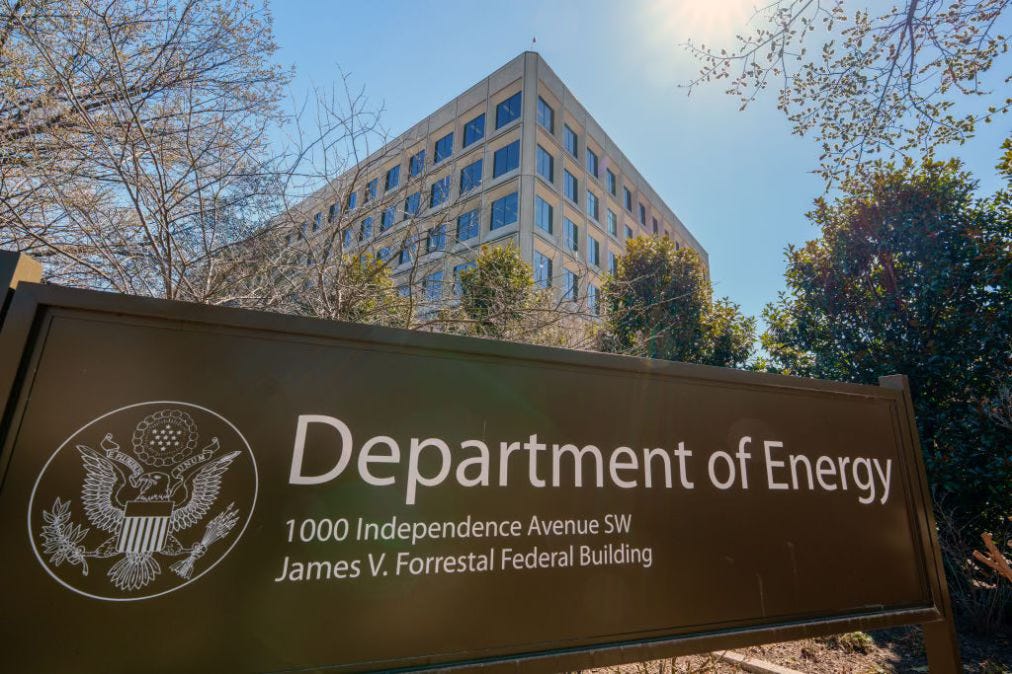
Weekend Reading: Nuclear & Uranium Catalyst Map
Week of March 23, 2026
We head into a data‑light but catalyst‑dense week for nuclear and uranium: policy forums, early‑stage conference chatter, and a still‑tight U33O88 tape where utilities are behind on contracting and macro load‑growth narratives (AI/data centers) continue to build.
1. Macro & Policy: Load Growth + Permitting + Critical Minerals
Data‑center load & federal response (ongoing)
The 2026 policy outlook remains anchored on unprecedented U.S. load growth from data centers, electrification, and new industrial demand, which is driving active FERC and DOE work on “large loads” and Section 202(c) emergency authorities.
For nuclear and uranium, this is effectively a demand‑side call option: any tightness in regional reliability strengthens the argument for life extensions, uprates, and advanced nuclear deployments as firm, zero‑carbon baseload.Permitting reform & transmission (ongoing)
Congressional efforts on permitting reform now explicitly target accelerated build‑out of transmission, generation, storage, and critical minerals infrastructure.
For fuel‑cycle names, faster permitting plus “critical minerals” framing increases the odds of policy support for non‑Russian enrichment, conversion, and upstream uranium, including potential government-backed offtake and financing structures.DOE critical minerals & innovation signals
DOE’s Critical Minerals and Energy Innovation priorities continue to emphasize federal capital for strategic materials and next‑gen energy technologies.
Uranium is increasingly being discussed alongside other critical inputs, with some analysts now explicitly hypothesizing U.S. equity stakes in miners in exchange for long‑term offtake and price floors—a structure already emerging in other critical materials.
2. Event Radar: Week of March 23
Why it matters: This week is about positioning into April–May: industry events, policy gatherings, and conference agendas will shape narrative beta for uranium, fuel‑cycle, and advanced nuclear equities into the next leg of the cycle.
Key scheduled items
Mar 23, 2026 – DOE‑linked events kick off the week
DOE’s public events calendar includes the 2026 Reservation Economic Summit (RES) commencement on March 23, which typically features sessions on energy, infrastructure, and federal support for tribal and regional development.
Watch for any nuclear‑adjacent language (tribal siting, transmission corridors, critical minerals) that could foreshadow targeted grant/loan programs relevant to uranium and advanced nuclear projects.Mar 25–26, 2026 – EMEA Modular & UK Large Reactor 2026 (EMUL2026), London
The EMUL2026 meeting in London (Modular & UK Large Reactor focus) runs mid‑week and will be a key forum for SMRs, large reactor life‑extensions, and UK/EU supply‑chain planning.
Expect incremental color on: UK financing models (RAB structures), vendor short‑lists, and the degree of urgency around fuel‑cycle reshoring away from Russian supply, which feeds directly into medium‑term contracting sentiment.Ongoing – Advanced nuclear “first movers” at policy forums
The broader 2026 energy policy conference circuit (NASEO, NEI, others) is running sessions on “Advanced Nuclear First Movers” and state‑level project development for grid resilience and industrial load.
The messaging consistently highlights nuclear as a key response to data‑center and industrial demand, reinforcing the structural demand case for uranium and specialized isotopes beyond this week’s specific events.
Near‑term industry conference pipeline (next 3-4 weeks, for positioning)
World Nuclear Fuel Cycle 2026 – Apr 14–16, Monaco
A core fuel‑cycle meeting where utilities, traders, and producers re‑anchor price expectations and long‑term contracting strategies.
Given today’s tight fundamentals and years of under‑contracting, we see a high probability of more constructive messaging on term prices and non‑Russian supply diversification.Economist “Nuclear Summit” – Apr 15, London
A policy‑heavy event where nuclear is explicitly framed as a tool of geopolitics, commerce, and innovation, with a focus on regulatory acceleration and new financing models.
Any public commentary around sovereign guarantees, regulated asset base models, or strategic fuel‑chain investments will be read through to equity risk premia and cost‑of‑capital assumptions for core holdings.
3. Uranium Tape & Fundamentals: What’s Priced In?
Spot & futures context heading into this week
Uranium spot prices rallied to roughly the low‑100s per pound in January before retracing to the mid‑80s by late February/early March, a roughly 15% pull‑back that still leaves levels well above 2025 averages.
TradeTech’s recent weekly read had spot around 85 dollars per pound with light transaction volumes, underscoring that price discovery is occurring in a thin, investor‑influenced market rather than a fully utility‑driven tape.Long‑term contracting still in “catch‑up”
Industry consultants highlight that utilities have under‑contracted uranium relative to reactor needs for 13 straight years into 2025, pushing uncovered requirements further into the future.
The result is a growing backlog of deferred demand that raises the risk of a more abrupt return to the market with larger volumes, fewer counterparties, and higher clearing prices—especially as non‑Russian supply constraints bite.Supply‑side tensions remain unresolved
Kazakhstan’s tightened exploration controls and messaging that current prices are still not high enough to justify unlocking substantial new production reinforce the idea that the supply response will be slow and price‑sensitive.
Layer on the potential for government equity stakes and offtake‑backed financing, and the right tail for quality producers, fuel‑cycle infrastructure, and advanced enrichment remains very much alive into and beyond this week.
Quick uranium‑market snapshot
DimensionCurrent Read‑ThroughSpot price levelMid‑80s per lb, off January highs >100 but still well above 2025 averages.Term/long‑term pricingLong‑term indicators around high‑80s to 90 per lb; term still pricing in structural tightness.Contracting behavior13th consecutive year of under‑contracting versus replacement needs; uncovered demand building.Supply responseKazakhstan tightening controls; current prices viewed as insufficient to incentivize future supply.Policy overlayCritical‑minerals framing + potential state equity/offtake structures increasingly in focus.
4. How We’re Framing the Week for Clients
Narrative drivers, not single “binary” catalysts
This is a week where most of the action is in language and signaling: what policymakers and industry leaders say about load growth, transmission constraints, and critical‑minerals strategy will inform how aggressively utilities and governments move on nuclear and uranium over the next 12–24 months.Positioning into April’s fuel‑cycle and policy summits
With World Nuclear Fuel Cycle (Monaco) and the Economist Nuclear Summit (London) less than a month away, we see current price consolidation as an opportunity to tighten exposure into higher‑quality producers, fuel‑cycle infrastructure, and advanced nuclear platforms that stand to benefit from more explicit policy and contracting signals at those meetings.Risk lens: liquidity and headline volatility
The uranium spot market remains thin and sensitive to flows from financial buyers and episodic utility activity, which can produce 10–20% drawdowns without any real change in structural fundamentals.
Into this week, we are watching for headline risk (policy comments, conference soundbites) as a source of short‑term volatility, but our medium‑term view remains that current pricing still underestimates the depth and duration of the contracting “catch‑up” phase.